AI Traffic Now Converts Better Than Other Channels. Is Your Business in the Answer?
A year ago, visitors who arrived from ChatGPT, Perplexity, Gemini and other AI assistants were browsers, not buyers. That has changed. According to Adobe’s latest research on US retail sites, AI traffic now converts better than traffic from other channels. The question for every business owner is simple: when a buyer asks an AI tool who to hire or what to buy, is your name in the answer?
Key takeaways
- AI-referred traffic to US retail sites grew 393% year over year in the first quarter of 2026 (Adobe).
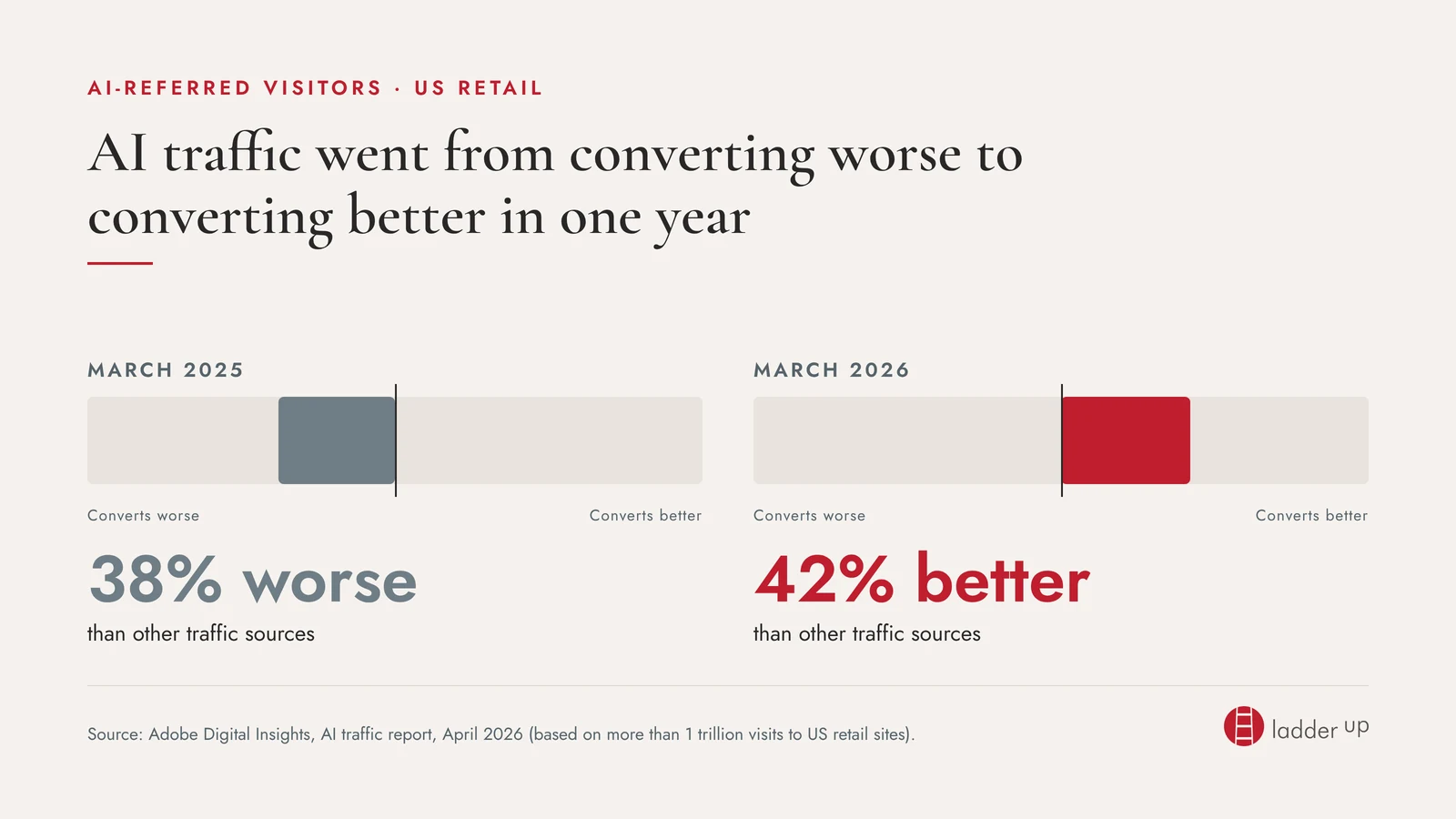
- In March 2025, that traffic converted 38% worse than other channels. By March 2026, it converted 42% better.
- AI assistants name businesses that are mentioned in the right places: best-of lists, community discussions, earned media and clear, well-structured websites.
- Showing up in AI answers is now a revenue question, not an experiment. It takes deliberate work on your site and beyond it.
How fast is AI traffic growing?
Very fast. Adobe Digital Insights, which analyzes more than one trillion visits to US retail sites, reported that traffic from generative AI sources was up 393% year over year in the first quarter of 2026. During the 2025 holiday season, it was up 693%.
AI is still a smaller source of visits than search engines or social media. But it is growing faster than any other channel, and buyers are using it at the moment they decide. In the same Adobe research, 39% of more than 5,000 US consumers surveyed said they had already used AI for online shopping.
Does AI traffic actually convert?
It does now. This is the number that should get an executive’s attention. In March 2025, visitors from AI assistants converted 38% worse than visitors from other channels. By March 2026, they converted 42% better.
The same visitors also engage more. Adobe found they spend 48% more time on site and view 13% more pages per visit than other visitors. Revenue per visit from AI traffic was 37% higher.
Why the shift? By the time someone clicks through from an AI answer, the AI has already done the research for them. It has compared options, summarized reviews and shortlisted a few names. The visitor arrives informed and closer to a decision.
A note on the data: Adobe’s figures come from US retail and ecommerce sites. Professional services and B2B buying cycles are longer, but the pattern is the same: buyers are asking AI for shortlists before they ever visit a website or pick up the phone.
How do AI assistants decide which businesses to recommend?
AI assistants do not rank websites the way a search engine does. They build an answer from what credible sources say about a category, then name the businesses that keep coming up. The brands that get named are the ones mentioned in the right places.
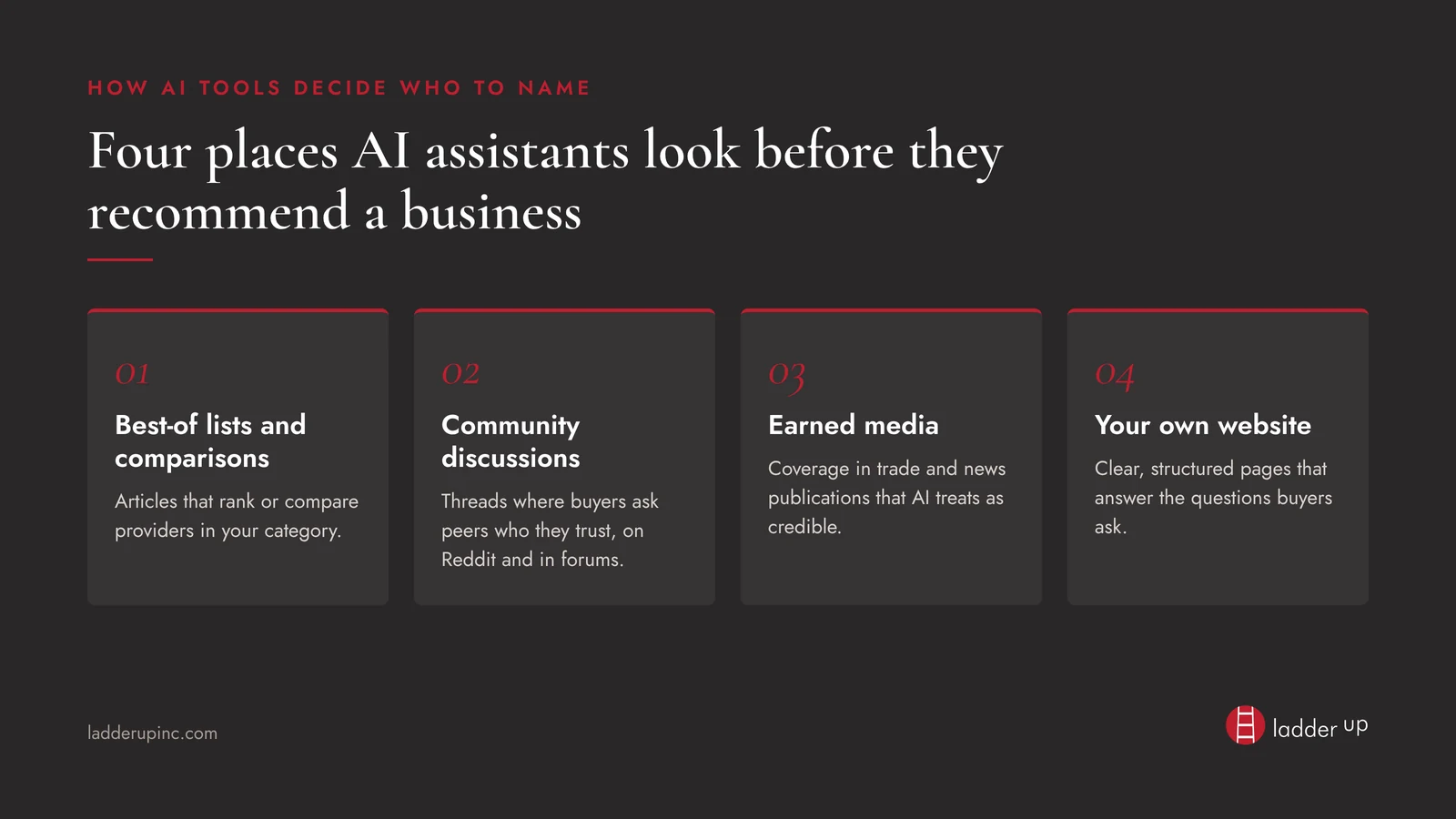
- Best-of lists and comparison articles. When someone asks “who are the best providers of X,” AI tools lean heavily on articles that already rank or compare providers. If you are not on those lists, you are unlikely to be in the answer.
- Community discussions. Reddit threads and industry forums are where buyers ask peers for honest recommendations. AI tools read and cite these conversations often.
- Earned media. Coverage in trade publications and news outlets signals authority. It also gives AI a trusted, third-party description of what you do.
- Your own website. Adobe found that a large share of retail page content still cannot be read properly by AI tools. Clear service pages, direct answers to common questions and clean structure make it easy for AI to understand and describe your business.
What should business leaders do now?
Start by finding out where you stand, then work on the places AI looks. In practical terms:
- Ask the AI tools yourself. Type the questions your buyers ask into ChatGPT, Perplexity and Gemini. Note who gets named and which sources are cited. That is your competitive map.
- Audit your own site. Check that your key pages answer real buyer questions in plain language and that AI tools can read them. Our SEO, AEO and GEO Audit covers both traditional search and AI visibility.
- Get onto the lists AI cites. AI Recommendation Placements put your business into the best-of and comparison articles AI tools draw from.
- Join the conversation. Reddit Brand Presence builds a genuine, helpful presence in the communities where your buyers ask for advice.
- Earn credible coverage. An Earned Media Campaign secures coverage in publications that build authority with both people and AI.
- Make it ongoing. AI answers change as new content appears. The Search and AI Authority Sprint combines these efforts into one focused push, and the SEO, AEO and GEO Monthly Plan keeps the work moving month to month.
You can see how these pieces fit together on our SEO, AEO and GEO Optimization page.
Is your team using AI as well as being found by it?
Your buyers are using AI to make decisions. Your team can use it to work faster, too, from content and social media to customer questions on your website. If you are not sure where to begin, our Getting Started with AI services and the AI Starter Pack set up AI in your social media, website and email, then train your team to keep it running.
Frequently asked questions
What is AI traffic?
AI traffic is website visits that come from generative AI tools such as ChatGPT, Perplexity, Gemini and Copilot, usually when a user clicks a link or citation in an AI answer.
How much did AI traffic grow in 2026?
Adobe reported that AI-referred traffic to US retail sites grew 393% year over year in the first quarter of 2026.
Does AI traffic convert better than other channels?
According to Adobe, yes. In March 2026, AI traffic to US retail sites converted 42% better than other channels. A year earlier, it converted 38% worse.
What are AEO and GEO?
AEO (answer engine optimization) and GEO (generative engine optimization) are the work of making your business easy for AI tools to find, understand and recommend. They build on traditional SEO and add the off-site mentions AI tools rely on.
How do I get my business mentioned by ChatGPT?
Be mentioned in the sources AI tools trust: best-of and comparison articles, community discussions, earned media coverage, and a clear, well-structured website that answers buyer questions directly.
Source: Vivek Pandya, Adobe Digital Insights, “Adobe report: U.S. retailers see surge in AI traffic, but many websites are not entirely readable by machines,” April 16, 2026.
Want to know if AI is recommending you?
Talk to a senior marketer. We’ll show you where you stand in AI answers and what will move your business forward.
Book a Free Strategy Call